
Short Courses and Student Programs
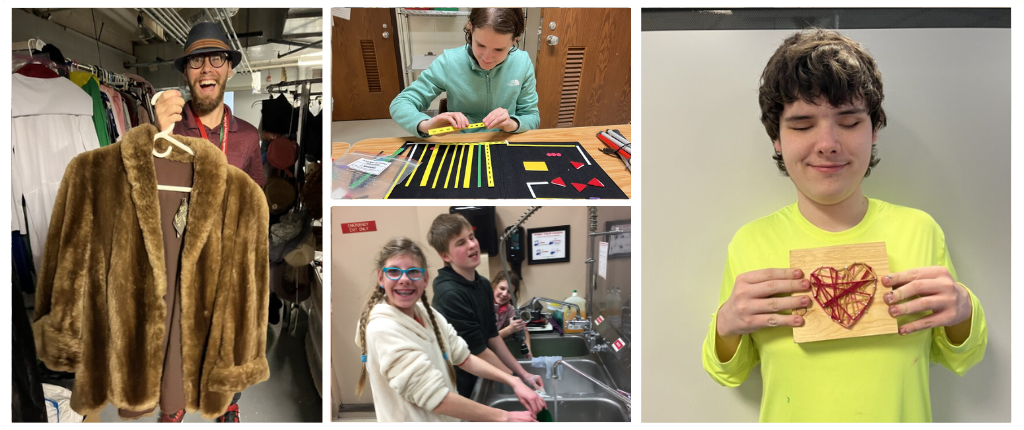
In order to promote, facilitate, and provide appropriate educational opportunities for all Wisconsin children who are blind or visually impaired, regardless of their educational placement, Outreach staff offer Individual and Group Short Courses with an emphasis on the Expanded Core Curriculum (ECC).
This year, the student programming team was awarded two Glen Stacy grants. For one of these grants, they are excited to offer a Monthly Expanded Core Curriculum (ECC) Challenge. Any Wisconsin student who is blind or visually impaired is eligible to participate in the ECC Monthly Challenge.
What is the ECC Monthly Challenge?
The Expanded Core Curriculum (ECC) Monthly Challenge is a way for students to gain more experience in each area of the ECC. Each month of the school year, a menu of activities will be posted on this webpage. All the activities for that month will focus on a different area of the ECC. Students can complete activities individually, with their families, or at school if they are able. For each activity students complete from the menu that month, they can earn an entry to win a prize related to the ECC area that month. Students will need to submit proof of the activity they complete, which could be done in a variety of ways based on the activity. There will be five winners this month.
When you have completed as many activities as you wish to do for this month, complete the form for that month. Make sure you have any pictures or documents needed for submission saved and ready in a place you can access them. You will be asked to upload them or complete a reflection if that was an option for the activity.
September ECC Challenge Submission Form. – Submissions will close on October 23, 2026 at 5:00 PM.
October ECC Challenge Submission Form – Submissions will close on November 13, 2026 at 5:00 PM.
October – Orientation and Mobility
What is Orientation and Mobility?
Orientation and mobility, often referred to as, “O&M”, is the area of the ECC where students learn the concepts and skills necessary to get from one place to another as safely, efficiently, and independently as possible. O&M is answering the questions “where am I” and “how do I get where I want to go”. Orientation and mobility teaches body, spatial, environmental, and directional concepts. Orientation and mobility skills include but are not limited to using the long cane, bus travel, sensory efficiency skills, and mobility skills. Orientation and mobility instruction occurs in the home, school, and community environments, per the Individuals with Disabilities Education Act (IDEA). Orientation and mobility instruction often enhances other areas of the ECC such as social skills, assistive technology, and self-determination. An example of orientation and mobility instruction is teaching a child how to cross at a four-way, stoplight-controlled intersection, using non-visual skills and a long cane.
O&M Activities
- Play a game of Simon Says with a friend or family member; use as many directional concepts as you can. For example, Simon says, “take 10 steps north.” Or Simon says, “think about the clockface and jump to 10:00”. Keep track of how many directions you could give using directional words and report the number.
- October 15th is White Cane Safety Day. If you receive O&M instruction talk to your O&M instructor, teacher or principal about how you could share White Cane Safety Day with your class or school. Share your knowledge with your class or school and have someone take a picture of you sharing your knowledge or submit what you did to share your knowledge of White Cane Safety Day. Some ideas are:
- Write something about White Cane Safety Day for a newsletter.
- Write facts about White Cane Safety Day for morning announcements.
- Give a presentation to your class about White Cane Safety Day.
If you don’t receive O&M instruction, research what White Cane Safety Day is and talk to your teacher about how you could share what you learned about White Cane Safety Day.
- Take a picture celebrating White Cane Safety Day.
- Do a neighborhood scavenger hunt! Find the following items on a walk in your neighborhood or yard. Take pictures of each of the items and submit the photos.
- Something that makes noise
- A tree
- A number
- A sign
- Something smooth
- Design an obstacle course in a safe space with tactile markers, hoops, cones, or other items you have. Walk it with a cane, time yourself, and then beat your record! Have your family members try it. You could all try it under a blindfold and see who does the best. Take a picture or short video of the course you created to upload.
- Make a tactile map of your favorite room in your house or school using materials you already have. If you need any ideas of household items to use explore the Tactile Graphics on the Fly site for ideas, to make this map. Take a picture of it to upload.
September – Self Determination
What is Self – Determination?
Self-determination skills enable students to become effective advocates for themselves based on their own needs and goals. Self-determination is a crucial area of the ECC, as it focuses on giving students the skills and tools they need to advocate for themselves, and what they need to be successful. Self-determination allows students to be dependent on themselves, instead of others. Components of self-determination include self-knowledge, self-advocacy and empowerment, assertiveness, problem solving and goal setting, and self-directed and self-regulated behavior.
Self-Determination Activities
- Explain your eye condition to a new teacher, a friend, or a family member and complete a reflection survey. If you are not sure what your eye condition is, ask a family member, or your TVI what your eye condition is and learn about it from them or your own research and complete a reflection survey.
- Complete the Self-Advocacy and Self-Determination for Students course on the EMPOWER VI website and request a certificate of completion (this is part of the post survey). (Earn a bonus entry by creating a One-Page Profile)
- Explore ways to label and mark items and try one of them. You can use the article titled “Labeling and Marking: A Guide for Low Vision and Blindness” from the APH Connect Center to do this. Take a picture of what you have labeled to submit or complete a reflection.
- Label something new in your house or at school that will allow more independence. You do not need to be a new method for labeling just label an item that you have needed help using to allow you to use it independently. This could be a microwave, the washer or dryer, maybe an item in your classroom that doesn’t already have a label that you need assistance finding. Take a picture to submit or complete a reflection.
- Create a “bucket list” for the school year, come up with two goals you want to accomplish by the end of the school year. These goals don’t have to relate to your IEP and do not have to be school related; however they should be something you can accomplish. Then come up with action steps you can do to complete and achieve these goals. You can save this on a computer or take a picture of the completed activity to submit.
- Pack your lunch or school bag independently. If you have not packed a lunch before and this is something you are able to do, ask your parents if you can try to pack a lunch for a day with their help if needed. Take a picture while you complete this task to submit. If you can’t pack a lunch and you normally don’t pack your own backpack for school, pack your own backpack making sure you have all the items you will need for the next day. Start by doing this once a week and increase it to more days. Pretty soon you will be able to do this all on your own. Take a picture completing this task to submit.
- Explore ways to use a calendar/planner and try to plan a week to use it. Take a picture or screenshot of your calendar/planner for the week to submit.
- Explore ways to organize money and try one of the methods and complete a reflection. The Perkins website has a How to Identify Money with Low Vision Guide that covers many ways to organize and identify money for both blind and low vision.
- Complete the IEP Participation Rubric and reflect on your score in the form. This task does not need the submission form for you will be asked for the same information at the end of this form.
- Talk to your IEP case manager or TVI about how you can be more involved in your IEP and come up with action steps to make that happen, submit the action plan or complete a reflection.
- Do you cut your own food with a knife? Do you know how to use scissors? If you answered no, then this is your chance to practice! Get or make some playdough and practice cutting with a butter knife and scissors. Ask someone to take a picture of you practicing (it doesn’t have to be with your face in it) to submit.
- Do you dish your own plate of food? If not, this is your chance to practice. Prepare your own plate for a meal. This will help you know where each item is on your plate and can allow you to be more independent when eating. Ask someone to take a picture of you or your plate to submit.
- Help with a household chore that you have not helped with before to start to learn what it is and think about ways this chore might need to be adapted for you to complete independently and complete a reflection. Some ideas of household chores to try, you might even just try one of the steps in these examples:
- Taking out the garbage (gathering it from all the rooms, taking the bag to the garbage can or dumpster, take the can to the curb if you don’t have a dumpster)
- Doing the laundry (separating items, knowing what temperature to wash at, putting items in washer and adding soap, starting the machine, putting items in dryer that need to go in dryer and adding dryer sheet, stating the machine, taking clothes out of dryer, folding items, putting items away).
- Washing dishing (filling sink with water and adding soap, washing the dishes, rinse dish, place in drying rack or towel dry, put dishes away when dry).
- Using the dishwasher (loading dishes in dishwasher until full, adding soap or pod, start dishwasher, take dishes out of dishwasher when cycle is complete, put dishes away).
- Dusting
- Vacuum a room
- Sweep a room or space outside
- Mop the floor after sweeping or vacuuming
- Cleaning the toilet
Individual Short Courses
Please email wcbvi.outreach@wcbvi.k12.wi.us and put the words, “Individual Short Courses” in the subject line for more information or to begin a request, please fill out the interest form in the button above.
More Information
For more information about Short Courses, please email, wcbvi.outreach@wcbvi.k12.wi.us and put the words, “Short Courses” in the subject line. To request a Short Course, please complete an Outreach Service Request and select “Student Programming”.